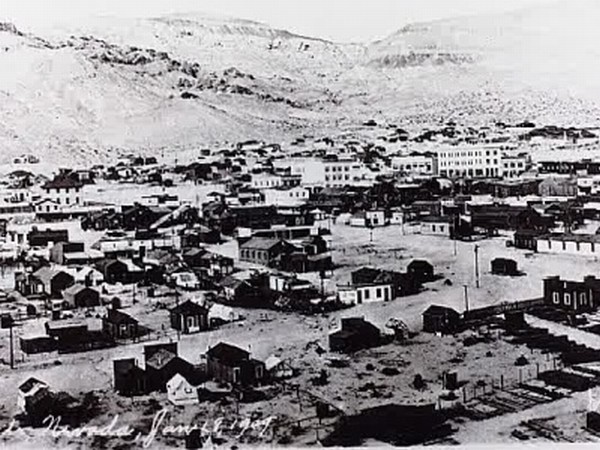
| This is what the town of Rhyolite looked like in 1909. Oddly enough my Buick rental had a flux capacitor, so all I had to do was hit 88 m.p.h. to get this photo. |
|
| This is what the town looks like now. They have really let this place go to seed. Unlike some of the ghost towns I would visit, this one is completely dead with no residents at all. If you look at both photos, you can clearly locate the school (left) and bank (center). |
|
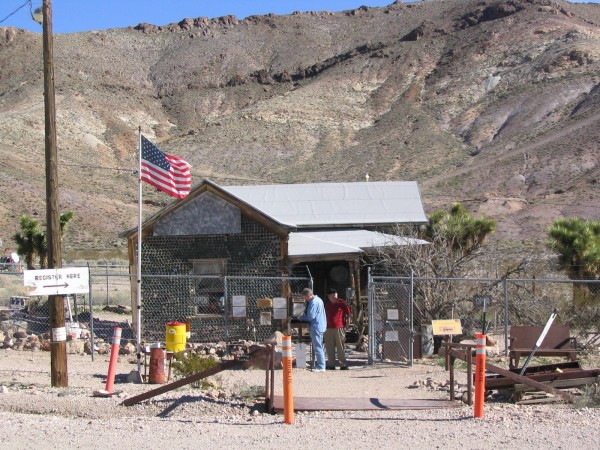
| The first thing you will see on a visit to Rhyolite is the famous bottle house. It was built by Tom Kelly in 1906 from the only material he had available. |
|
| Here's a closer look at the front of the house. It's basically bottles and mortar. One reason this house has survived is because it remained lived in until 1969. |
|
| A peek into the house. |
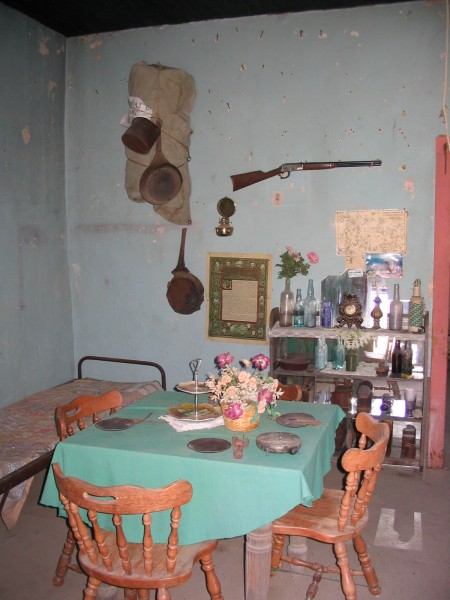 |
| Apparently most of the bottles came from this saloon. I don't know how old the building is or if it is original to the town. It's possible it could have been built from the remains of some of the older destroyed buildings in town. |
|
| This is the old Rhyolite jail. That metal door in the back of the front room leads to the cell area in back. |
|
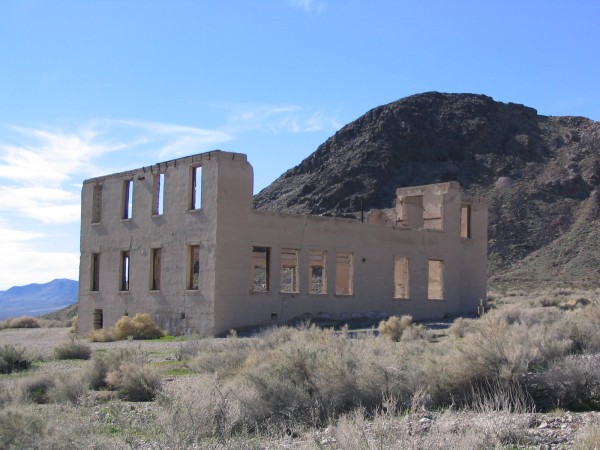
| The schoolhouse. |
|
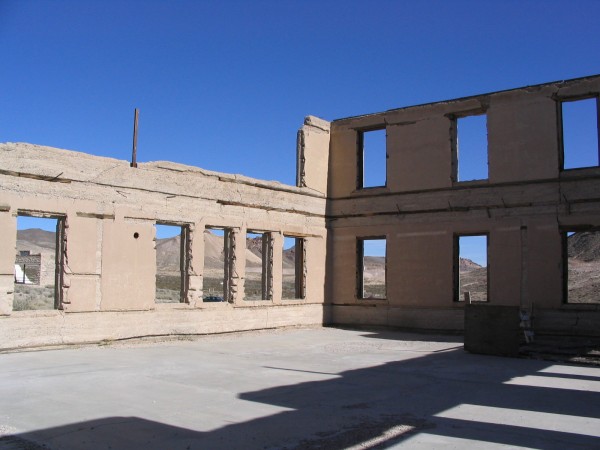
| The schoolhouse was two stories and included classrooms and an auditorium. This one replaced a previous school building that was too small for the town. The idea was to construct a large facility to accommodate an anticipated growth of the population of Rhyolite. However, this never came to pass. The school was never filled to capacity as the boom turned to bust shortly after it was completed. |
|
| Imagine some Rhyolite kid staring out of this window almost a century ago wishing he was outside playing rather than learnin' his readin, ritin and rithmetic. |
|
| The remains of the John S. Cook & Co. Bank building. It was the largest building in town. |
|
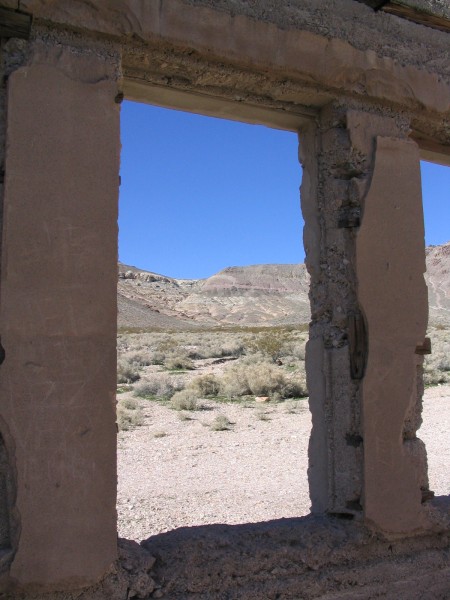
| Take a look through the front door of the bank. I'm not sure but those two openings might have been entries to a vault. The Post Office operated out of the basement. |
 |
| The building had Italian marble floors and mahogany woodwork. It was the last business to close in Rhyolite. |
 |
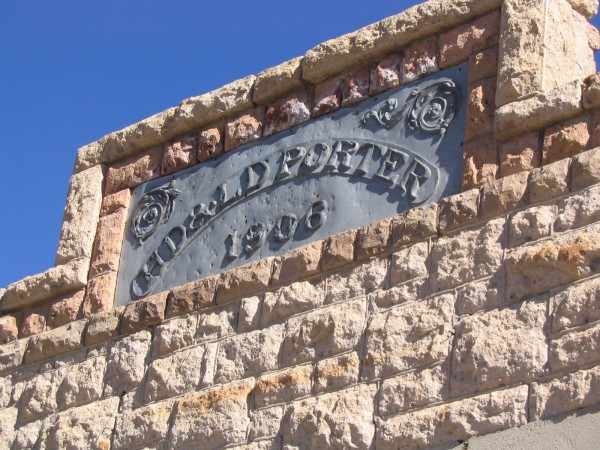
| The remaining storefront of H.D. & L.D. Porter. The Porters had mercantile stores throughout Nevada. This was quite a gem back in its day. |
 |
| A close-up picture of the sign over the storefront. The building was completed only a couple of years before the town started to disappear. |
 |
| This is the remains of the Overbury Building and Bishop Jewelry Store. |
 |
| It was after taking this photo of a building ruin that I stepped awkwardly on a rock and sprained my ankle. It would really swell up later in the day. I'll show you that a little later. |
 |
| I don't know what this building was. I wouldn't think Rhyolite had row homes. |
 |
| You can still drive the dirt streets of the town and imagine that there are buildings all around you. At its peak, there were upwards of 12,000 people living in Rhyolite. Now there's no one. |
 |
| This is the only stone building in town that completely remains intact. It was the rail station. From the look of the sign on the front of the building, it seems to have been turned into a casino at some point after the trains stopped coming. |
 |
| What's left of an old rail car. |
 |
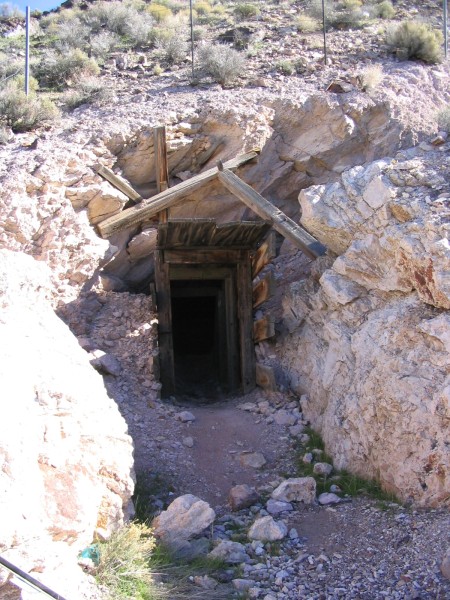
| Up on the hill was this mine shaft opening. It would have been great to go inside, but I don't know how safe it would have been. There was a barbed wire fence around it. Given my now swelling ankle, I wouldn't have been able to maneuver as well as I might have liked anyway. |
 |