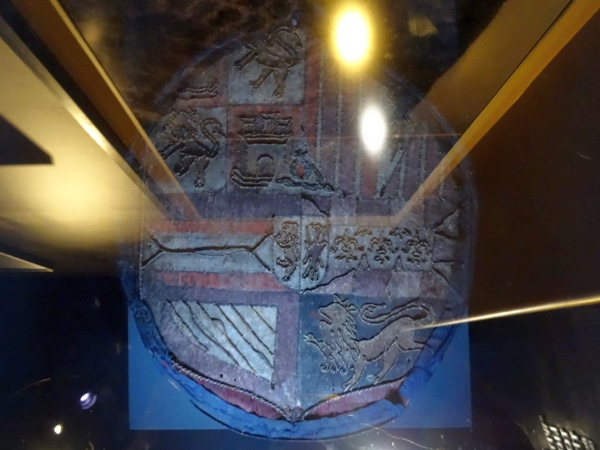
| In his 1598 entry into what is now New
Mexico, Don Juan de Oñate carried a banner with a
central medallion. This revered fragment, once part of his banner,
was preserved in Santa Fe and was saved by the Spanish during the
Pueblo Revolt in 1680. To protect the old fabric, this is kept under glass and a light is shown briefly every thirty seconds. |
 |
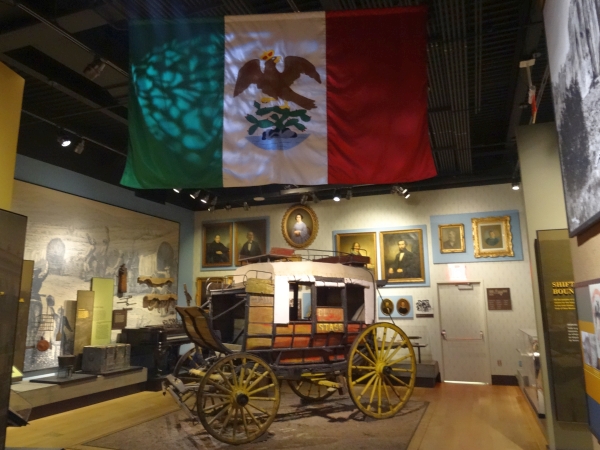
| Over the years, all or some of New Mexico has been part of Spain, Mexico, Republic of Texas, United States of America and Confederate States of America. |
 |
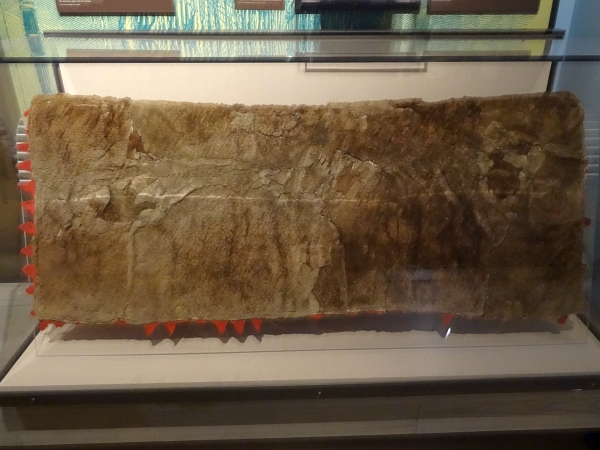
| Kit Carson was a frontier legend. This was a beaver skin robe he used during his years as a trapper. Before you get the idea that he caught an enormous beaver and skinned it, this is made from many small sections. |
 |
| This saddle belonged to Colonel Eugene Carr, who led cavalry units in the Civil War. One doesn't usually think of New Mexico being part of the war, but both the USA and CSA asserted territorial rights, with the Confederacy claiming the southern half as its own and waging a campaign to control the Southwest. |
 |
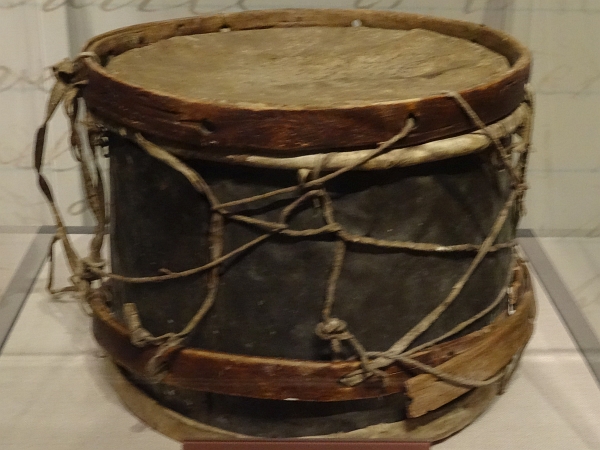
| A Confederate drummer likely carried this snare drum at the decisive Battle of Glorieta Pass that eventually led to the CSA abandonment of the Territory. |
 |
| We now move forward into some more
recent history. There was an exhibit featuring things about Harvey
House restaurants and hotels. The company was founded in 1876 by Fred Harvey to cater to the growing numbers of train travelers. He made a deal with the Atchison, Topeka & Santa Fe Railway to operate a series of hotels and restaurants along its rail lines. Most of the original Harvey Houses and hotels are gone, but one that still exists is the El Tovar Hotel on the South Rim of the Grand Canyon. |
 |
| One of the features of the restaurants
was the Harvey Girls. Fred Harvey looked for young, single,
intelligent women of "good character" to work as waitresses in the
unknown territory of the West. Of course quite often in some of the
far-flung locations in the West, the Harvey Girls were the only
single women for miles. I guess that "good character" must have been
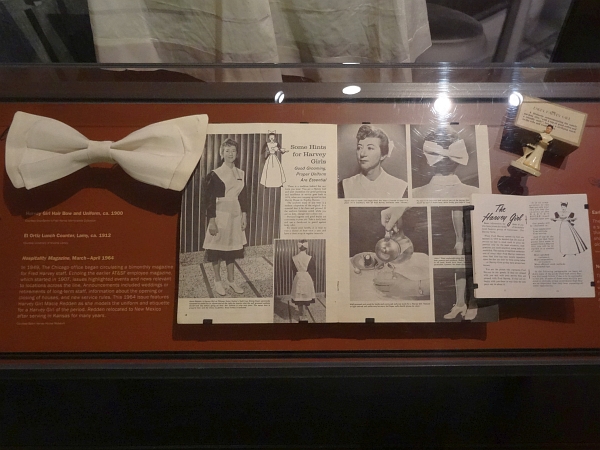
tested more than once by lonely men. The prototypical uniform consisted of a long black dress (no more than eight inches above the floor) overlaid with a starch white apron, black opaque stockings and black shoes. That must have changed at some point because there are photos of Harvey Girls wearing white shoes and stockings. |
 |
| From that 1964 Hospitality Magazine
article on display: Some Hints for Harvey Girls Good Grooming, Proper Uniform Are Essential There is a tradition behind the uniform you wear. You are a Harvey Girl and your reputation for good grooming and excellence in service goes back to 1876, when our company opened its first Harvey House in Topeka, Kansas. The uniform many of you wear is a modern adaption of the original. It is essential that it be clean and pressed. If the uniform becomes soiled while you are on duty, change into a clean one. Personal hygiene and good health are a necessity in your job. Take a daily bath and use a deodorant to guard against body odor. To ensure your health, it is wise to visit a doctor at least once a year and have a chest x-ray at regular intervals. |
 |
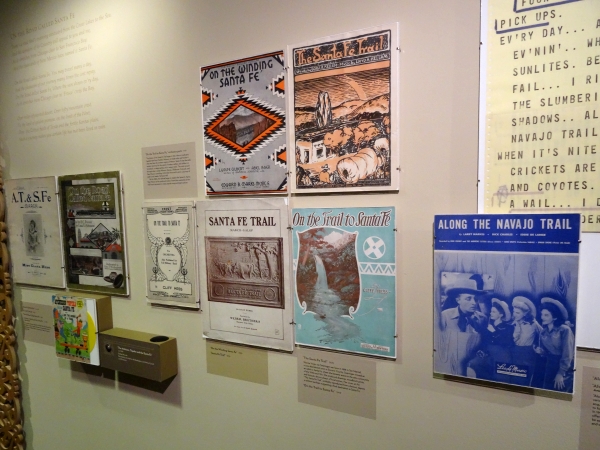
| There were surprisingly many songs written in some way about New Mexico. There were several boxes that played the various featured songs if you pressed the button. |
 |
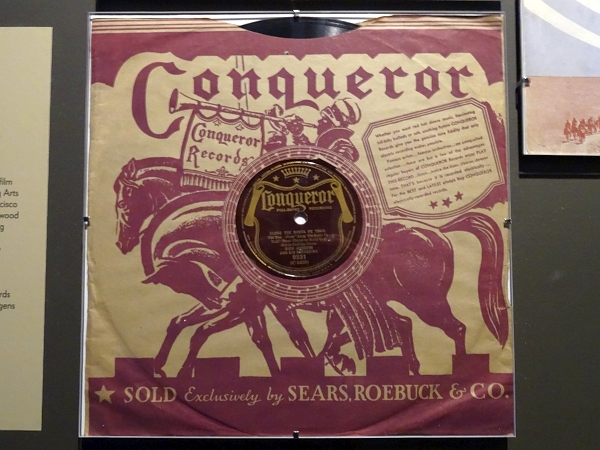
| An old copy of "Along the Santa Fe Trail" by Dick Jurgens and His Orchestra. This 78 rpm record was released in 1940. |
 |
| Many recordings and copies of sheet music for the 1903 song "Navajo", music by Egbert Van Alstyne and lyrics by Harry Williams. You can listen to an early recording of the song here. |
 |
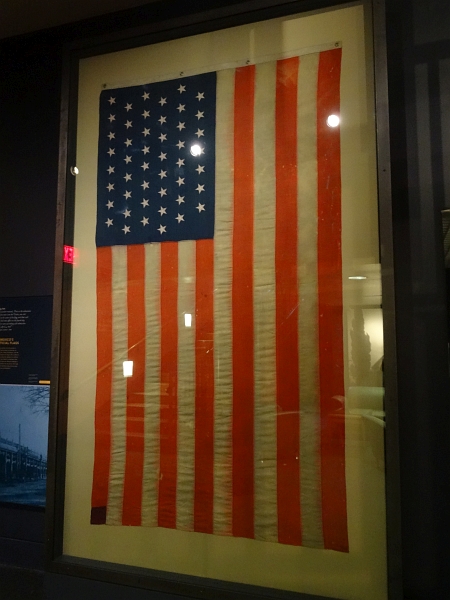
| When New Mexico was admitted to the Union on January 6, 1912 as the 47th state, they preceded Arizona's admission by 39 days. There is a federal law that requires that a new star not be added to the flag until the July 4 following statehood. But that didn't mean some people didn't go ahead and make some 47-star flags, even though they were unofficial. |
 |
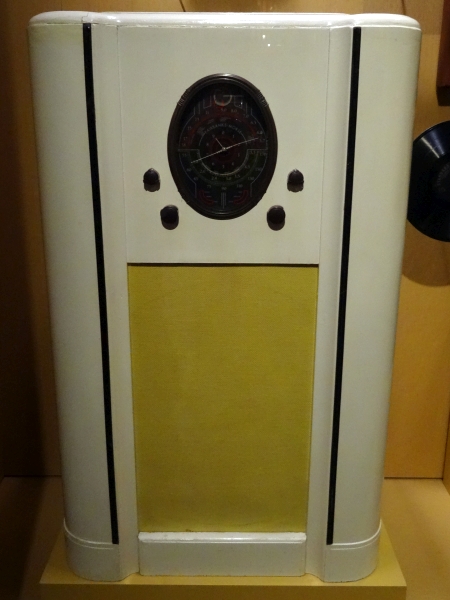
| An old Fairbanks-Morse radio, circa 1930's. |
 |
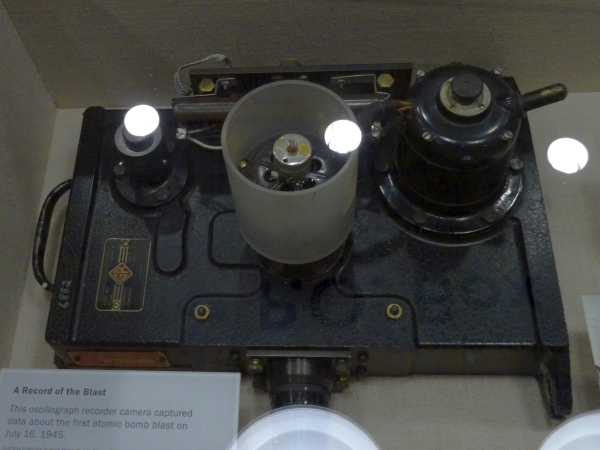
| This oscillograph recorder camera captured data about the first atomic bomb blast on July 16, 1945, which I have referenced several times by now. |
 |
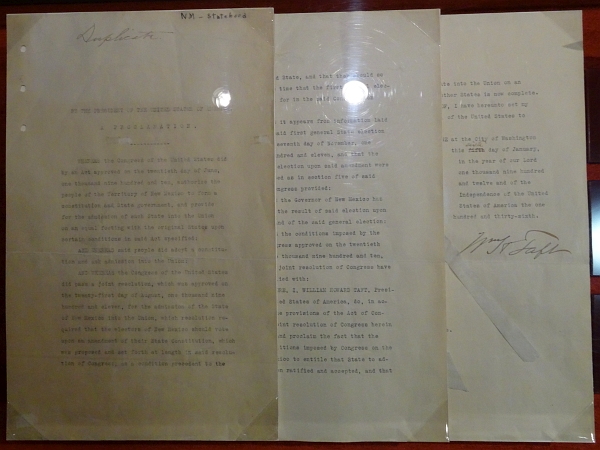
| A copy of the presidential proclamation admitting New Mexico to the Union signed by William Howard Taft. |
 |
| Jesus, that's a lot of Jesuses! |
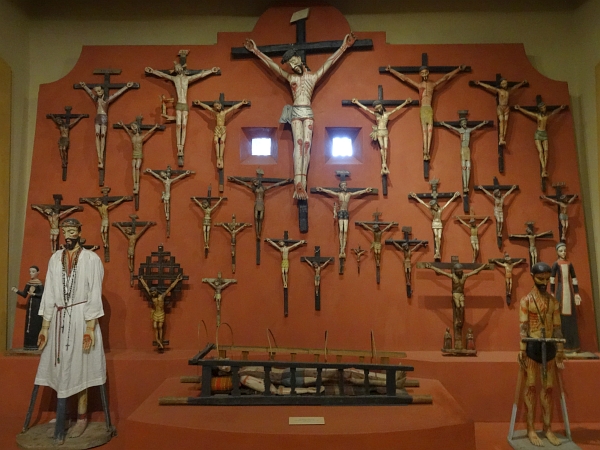 |
| This is in the Palace of the Governors,
or Palacio de los Gobernadores, section of the museum. It served as
the seat of government for New Mexico for centuries. This chapel presented here was not a recreation of one located in this building but represents a feeling of the simple beauty of chapels found across New Mexico. |
 |
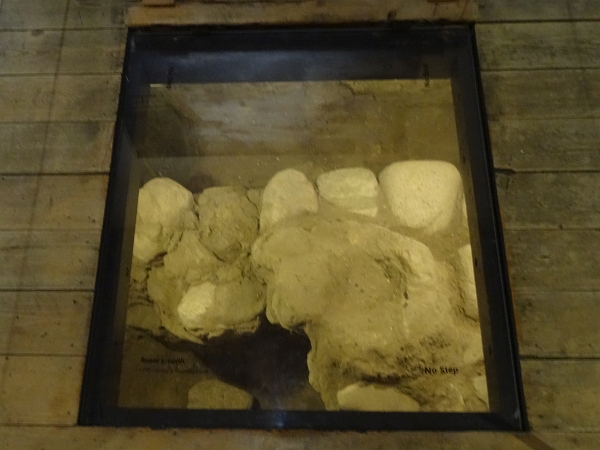
| During excavations in the mid-1970's, archeologists uncovered the best preserved evidence found to date of the 17th century Palace and Pueblo Revolt village built on top of it in 1680. |
 |
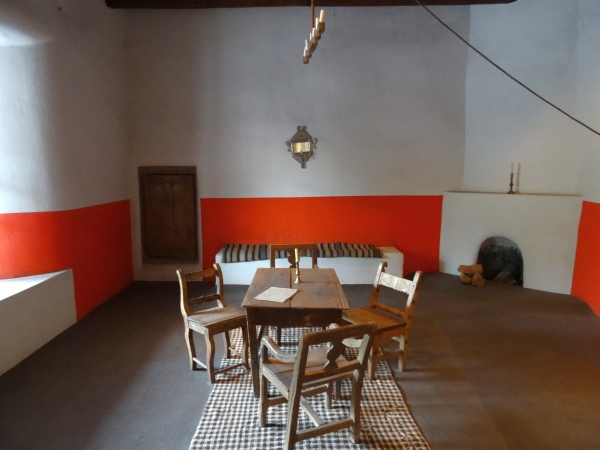
| A recreation of the Mexican Governor's office. |
 |
| An old 18th century Spanish colonial doorway. |
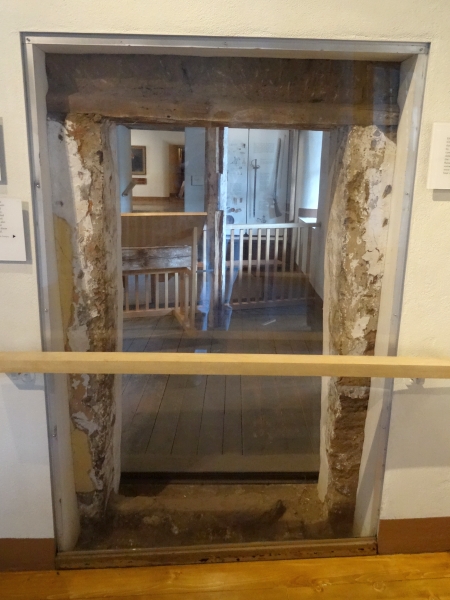 |
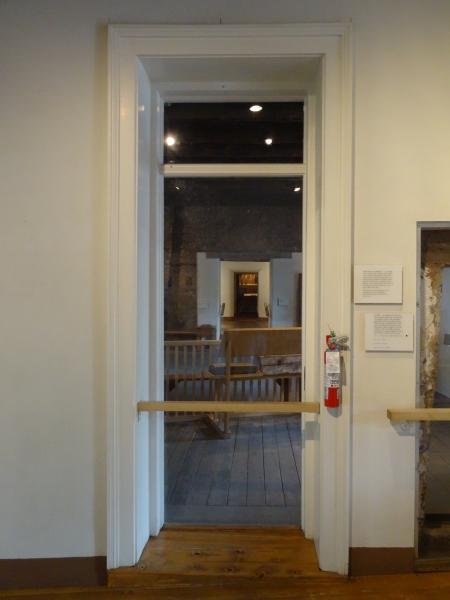
| A newer late 19th century Territorial doorway. You can see on the right a little of the old doorway and how much smaller they built them back then. This helped to conserve heat and also served a defensive purpose. |
 |